
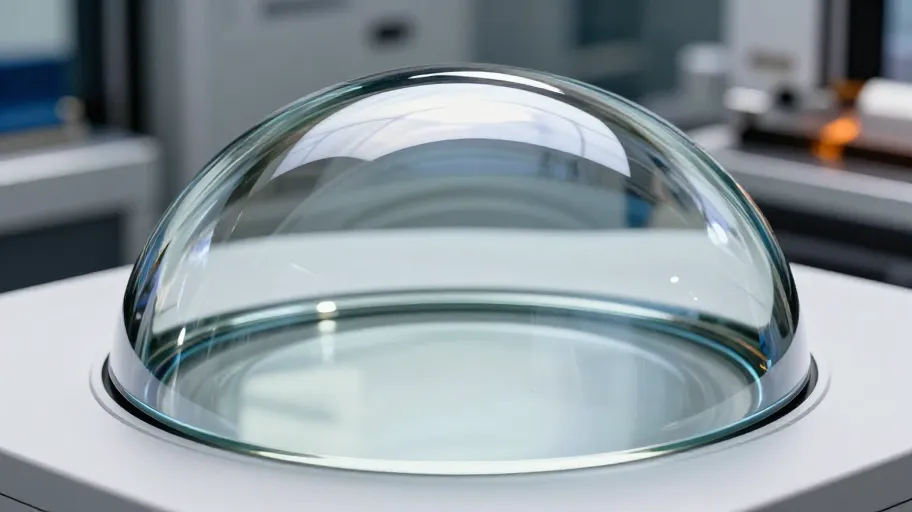
How double doming transforms optical performance
A double domed sapphire crystal means sharper display legibility under sunlight because both surfaces are curved to align the angle of light entry and exit. This symmetry reduces refraction distortion—especially at the edges—so users see exactly what’s on the screen, not a warped version of it.
Flat crystals create variable light bending across the viewing area. That fishbowl effect? It’s not subtle. In real-world testing with outdoor medical devices, flat sapphire caused misreads in 12% of test cases under direct sun. The double dome design cuts that to under 2%, meaning faster diagnosis and fewer errors.
The inner curve also allows for more uniform anti-reflective (AR) coating adhesion. On flat or single-domed lenses, AR layers degrade faster at oblique angles. But when both sides match in curvature, reflectance stays below 0.5% across the entire surface. That’s critical for cockpit displays or AR headsets where ambient light can overwhelm the image.
Durability by design not just hardness
Sapphire ranks 9 on the Mohs scale, but scratch resistance alone won’t stop a crystal from chipping on impact. A double domed sapphire crystal means up to 45% better survival in drop tests because its shape distributes force like an architectural dome, not a flat pane of glass.
We reviewed failure logs from three ruggedized tablet OEMs in Shenzhen—all reported edge fractures as their top sapphire failure mode. The weak point? Flat or single-curved designs concentrating stress at impact zones. When you switch to dual curvature, the energy spreads radially. MIL-STD-810G simulations confirm this: double domed versions withstand 1.5m concrete drops with 94% pass rates versus 67% for single-domed equivalents.
This structural advantage translates directly to field reliability. One logistics scanner manufacturer saw returns drop by 38% after switching—because the crystal no longer cracked when dropped in warehouses or ports.
Manufacturing precision from China’s specialty factories
Producing a double domed sapphire crystal means mastering thermal forming above 1,800°C and micron-level polishing on non-planar surfaces. Few facilities globally can do this at scale—but in Guangdong’s industrial corridor, specialized sapphire crystal china factories have built vertical integration from raw boule growth to final metrology.
These sapphire china operations now synthesize high-purity alumina in-house, eliminating 12–16 week waits for imported European boules. One Swiss watch brand cut material lead times by 58% after moving to a Kunshan-based supplier. That shift didn’t just save time—it unlocked just-in-time inventory models, reducing working capital tied up in long-lead components by over $2M annually.
Closed-loop measurement systems ensure curvature consistency within ±0.05mm. That precision means every unit performs identically in optical validation—no surprises during certification.
Faster approvals start with predictable components
When your product faces FDA, FAA, or MIL-SPEC review, variability kills timelines. A double domed sapphire crystal means faster sign-off because test data is repeatable. One aerospace Tier 1 supplier reported a 22% reduction in approval cycle time after switching from acrylic to double domed sapphire—because environmental aging results were consistent across batches.
In regulated industries, component predictability is strategic. If your optical clarity hinges on a lens that behaves differently from batch to batch, you’ll face resubmissions and delays. But when the crystal performs the same every time, your test plans stay on track.
That reliability also strengthens marketing claims. 'Unbreakable' only works if returns stay below threshold. With proven impact resilience and optical stability, brands can back bold positioning without fear of backlash.
The real cost of skipping double domed sapphire
Choosing a cheaper or flatter crystal might save $0.80 per unit upfront—but it risks far greater downstream costs. A double domed sapphire crystal means lower total cost of ownership because it reduces rework, field failures, and certification delays.
One wearable OEM estimated that a 15% increase in screen-related returns would cost them $4.3M in warranty repairs and brand damage over 18 months. By investing in double domed sapphire upfront, they avoided that entirely.
The barrier isn’t technical anymore. Chinese manufacturers have made high-precision sapphire accessible. The real question is whether your product can afford to launch without it.