
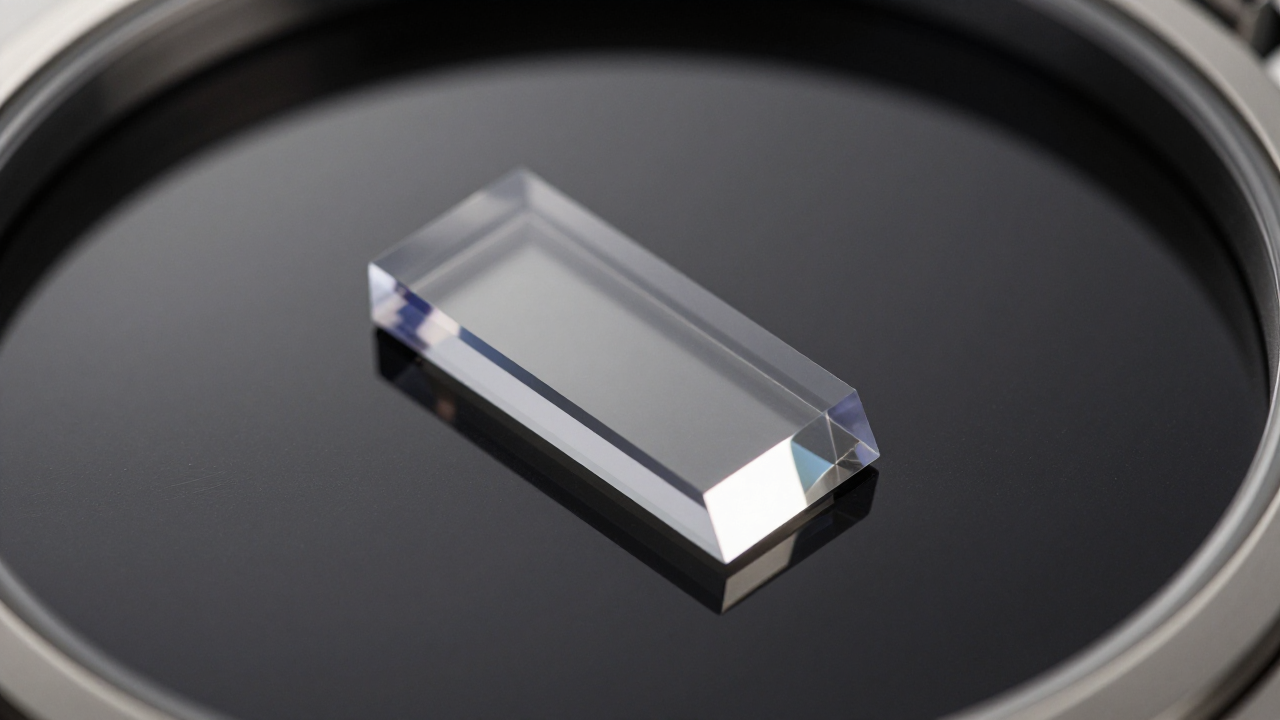
Four things decide whether you're still happy with the crystal two years from now: the grade of the synthetic sapphire substrate, the coating architecture on the top surface, the dimensional fit to…
your specific case, and whether the vendor can hand you batch-level test data. Price ranks fifth. Buyers who flip that order usually come back within a year, and not with a warranty claim they can win.
What Actually Matters When You Buy a Sapphire Watch Crystal
Sapphire is corundum, single-crystal aluminum oxide grown in a furnace rather than mined. Mohs 9. Vickers around 2,000 HV against roughly 550 HV for mineral glass and 25 HV for acrylic. That hardness number gets quoted on every spec sheet on the internet. What the spec sheet leaves out is that hardness means nothing if the crystal is glued in badly or the AR coating flakes off in the shower.
Quick calibration: ISO 14368-1 governs mineral and sapphire watch-glasses and sets dimensional and quality requirements most buyers never ask about. If your vendor has never heard of it, that tells you something.
The Four Dimensions That Decide Your Purchase
Four variables separate a $6 crystal from a $40 one: substrate grade, coating architecture, fit geometry, and batch traceability. Everything else on a quote sheet is downstream of these.
Substrate grade. Watch sapphire is not one material. The same furnace run that yields optical-grade material also yields screen-grade drops for phone cover glass. Optical grade means internal bubble content under about 0.3% by volume with low residual strain; screen grade tolerates far more. The major boule growers — Kyocera in Japan, Rubicon Technology in Illinois — sell into both the watch and the LED markets, and the grade you get depends entirely on which lot your supplier bought. Under a 10x loupe, a screen-grade crystal shows faint cloudy inclusions near the edge. They're invisible in product photos. They show up in a customer's photo of a black dial under a desk lamp. Coating architecture. Uncoated sapphire transmits about 85% of visible light. Single-side AR gets you to roughly 92%. Double-side AR with ion-assisted deposition (IAD) reaches 97–98%, with a greenish or bluish reflection depending on the stack design. The deposition method matters more than the layer count. Standard e-beam deposition produces a coating a nylon brush can dull in 18 months. IAD costs the factory maybe 30% more per part and multiplies coating life several times over. Ask which one you're being quoted. Vague answers are answers. Fit geometry. The diameter on your invoice is not the number that matters. What matters is the bezel opening ID, the gasket groove depth, the thickness the case was machined for, and the edge profile — flat, chamfered at 30° or 45°, or step-cut. A 0.10 mm oversize crystal in a press-fit case cracks on install about one time in four. An undersize one seals against nothing. Batch traceability. Ask for the coating adhesion result (ASTM D3359 cross-hatch) and a sampling plan. We've been cutting sapphire in Shenzhen since 2010, and the buyers who ask for ASTM D3359 paperwork are the ones still reordering eight years later. A trading desk can't produce it.How Do You Pick the Right Thickness and Fit?
Pick thickness from the case design, not from a spec sheet, and match diameter to the bezel opening ID rather than the case diameter. Going thicker than the original design almost never improves water resistance or optics, and it often hurts both.
Real production ranges: 0.8–1.0 mm flat crystals for dress watches under 38 mm. 1.2 mm flat or single-dome is the volume workhorse across 40–42 mm sport cases. 1.5–2.0 mm covers double-dome and box crystals on dive watches and vintage rebuilds. Tolerance practice separates suppliers fast. Mass-market production typically holds ±0.10 mm on diameter. Good shops hold ±0.05 mm. The best hold ±0.02 mm on the OD and control chamfer angle to ±1°.
One that bit us. In August 2021 a customer in Broomfield, Colorado returned 400 pieces of a 1.2 mm flat crystal for a 41 mm field watch, complaining about fogging. We measured them. Dimensions were perfect. The problem was the gasket: the case used a 0.6 mm O-ring, and the customer reused stock that had been sitting in an unsealed bin since 2019. The rubber had taken a compression set. Crystal was never the issue. We now ship a gasket with every crystal and print the durometer on the packing list. Buna-N at 70 Shore A is the default; FKM if the watch sees sunscreen and chlorine.
Budget Tiers and What Your Money Actually Buys
A note on that top row. We've quoted against $2.80 crystals more than once. They work fine, right up until a customer scratches one and posts it. If your brand lives on Instagram, the $2.80 crystal is a marketing liability, not a saving. (The sample freight is what actually hurts — $70 to ship two crystals to the US, which is why so many buyers skip it and regret it.)
How to Tell Real Sapphire From Sapphire-Coated Mineral Glass
Real sapphire passes a thermal conductivity test; coated mineral glass does not. Photos, listings, and sales copy will not help you. The material will.
The phrase "sapphire glass" on a sourcing listing means almost nothing. So does "sapphire coated," which describes a mineral glass substrate with a hard coating. Real single-crystal sapphire and coated mineral glass look identical in photos and feel nearly identical after a few seconds of handling.
The reliable field test is thermal. Sapphire runs around 27 W/m·K, roughly 20 times mineral glass. A sapphire crystal pulls heat off your fingertip fast enough to register as noticeably cold for two to three seconds; mineral glass goes neutral almost immediately. A jeweler's diamond tester works too, because those devices measure thermal conductivity and sapphire reads in the same neighborhood as diamond.
The Casio GMW-B5000SB-1A2 is a useful example of how this gets muddled. Four blue sapphires sit on that G-Shock's bezel as decorative stones; they were never meant to be the crystal over the dial. Decorative corundum and a watch crystal are two different product lines with two different spec sheets. When a listing leans on the word "sapphire," figure out which one it's selling.
Two Numbers That Never Make It Onto the Quote
Two specs decide whether two crystals with identical-looking quotes are actually the same product. Neither one shows up on a standard price sheet.
Bubble content and strain grade. Vendors quote "sapphire crystal" and stop. The gap between optical grade and screen grade is worth $3 to $9 per piece and is invisible until the part is assembled. Ask for the inclusion spec in writing. A vendor who says all their sapphire is the same is telling you they buy from wherever the lot is cheapest that week. Coating thickness in nanometers, and which side it's on. Double-side AR is not automatically better than single-side. If the inner coating sits close to a printed chapter ring, the coating can produce a visible color shift at oblique angles. We've watched a navy dial read purple at 40 degrees of tilt because of a 4-layer inner stack. Some brands want that effect. Most don't know they're buying it. Specify target side and reflection color, then approve a coated sample before committing to a run.Traps We've Watched Buyers Walk Into
Making the Call
Choose the budget tier if you're building samples, selling under $80 retail, or replacing crystals on watches where the customer will never look twice. Your margin can't absorb $30 of glass, and nobody will notice.
Choose the $22–55 tier if your brand sells on perceived quality and the crystal has to survive three years of a customer's gym routine without dulling, because that's the point where a double-dome optical-grade sapphire watch crystal with IAD double AR stops being a line item and starts being a reason people buy your watch twice.
Frequently Asked Questions
How hard is a sapphire watch crystal?
Sapphire rates 9 on the Mohs scale and about 2,000 on Vickers hardness, against roughly 550 for mineral glass. Only diamond and a few synthetics scratch it in normal wear. It is brittle, though, and a sharp hit against a stone edge can chip the rim.
How much should a sapphire watch crystal cost?
Volume pricing for a 1.2 mm flat crystal with double-side AR runs $6 to $18 per piece at 500 units. Double-dome box crystals in optical grade run $22 to $55. Anything under $4 is screen-grade material with thin or no coating.
Can you replace mineral glass with sapphire?
Usually yes, if the case has a removable bezel or a press-fit crystal. You must match the original thickness within 0.1 mm and use a fresh gasket, since sapphire is stiffer than mineral and will not conform the way the old glass did.
How long does sapphire crystal AR coating last?
Ion-assisted deposition coatings hold up for years of daily wear. Standard e-beam coatings can show visible dulling in 12 to 18 months of regular cleaning with a cloth or brush. Ask which deposition method your supplier uses before ordering.
What is the difference between sapphire glass and sapphire crystal?
Sapphire crystal is single-crystal aluminum oxide grown in a furnace. Sapphire glass usually means mineral glass with a hard coating, or a branded term for the same thing. They are not interchangeable, and the pricing gap runs two to five times.